
by Lucy Lambe
Iconoclasm denotes a site where social, political, cultural, and often sexual tensions converge—culminating in the destruction or suppression of images. Censorship, as David Freedberg (2016) asserts, constitutes a form of iconoclasm driven by fear: the fear that art possesses agency, that it becomes what it depicts. Art, therefore, transcends aesthetics and becomes a site where power is negotiated.
Across history, acts of image destruction—from the erasure of pharaonic portraits in ancient Egypt to the mutilation of royal imagery during the French Revolution—have testified to art’s power. Religious censorship, too, has mirrored this anxiety, as seen when Pope Paul IV ordered Daniele da Volterra to cover the nudes in Michelangelo’s Last Judgement.
Andres Serrano’s Immersion (Piss Christ) (1987) exemplifies the modern intersection of art, morality, and censorship. Initially exhibited to critical acclaim, the work soon provoked outrage for depicting a crucifix submerged in the artist’s urine. Serrano faced death threats, and the artwork was physically attacked in several countries, including Australia and France. The intensity of public reaction ultimately led to the establishment of the 1998 U.S. “decency law,” illustrating how fear and misunderstanding of intent can catalyse institutional censorship.
Similarly, Leena McCall’s 2014 portrait of a woman revealing a glimpse of pubic hair was removed from the Mall Galleries in London. Officials justified their decision by citing potential exposure to children—a rationale that underscored persistent unease surrounding female sexuality in visual culture.
In 2019, Stéphane Simon’s sculptural installation In Memory of Me, displayed at UNESCO’s World Heritage Days, faced intervention when curators covered the figures’ genitalia. The artist’s commentary on classical form and selfie culture was thus compromised by a gesture of prudish moralism, criticised by many as emblematic of cultural regression.
American artist Anita Steckel responded to the moral restrictions imposed upon women artists by founding the Fight Censorship group alongside artists such as Louise Bourgeois, Martha Edelheit, and Hannah Wilke. Steckel sought to challenge the exclusion of sexual content from women’s art and to demand parity with male contemporaries. Her manifesto declared:
We demand that sexual subject matter, as it is part of life, no longer be prevented from being part of art.
— Anita Steckel
Steckel’s practice, which addressed gender, objectification, and social justice, used photomontage to subvert patriarchal iconography. She referred to her work as “Mom Art” to oppose the masculine overtones of Pop Art. When Steckel’s first solo exhibition, The Sexual Politics of Feminist Art (1972), coincided with a teaching application, institutional discomfort with her sexually explicit imagery led to her rejection. Although she was encouraged to remove controversial works, Steckel refused—choosing integrity over compliance. Her career represents a vital feminist intervention in the history of art censorship, demonstrating that suppression of erotic or political imagery often functions to preserve patriarchal authority.
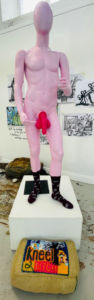
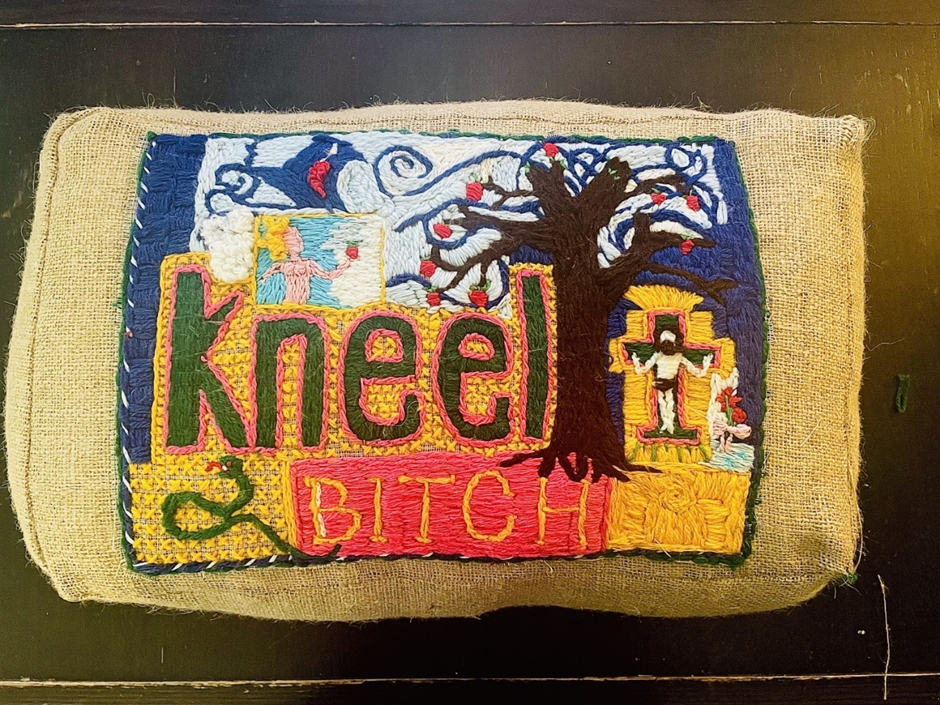
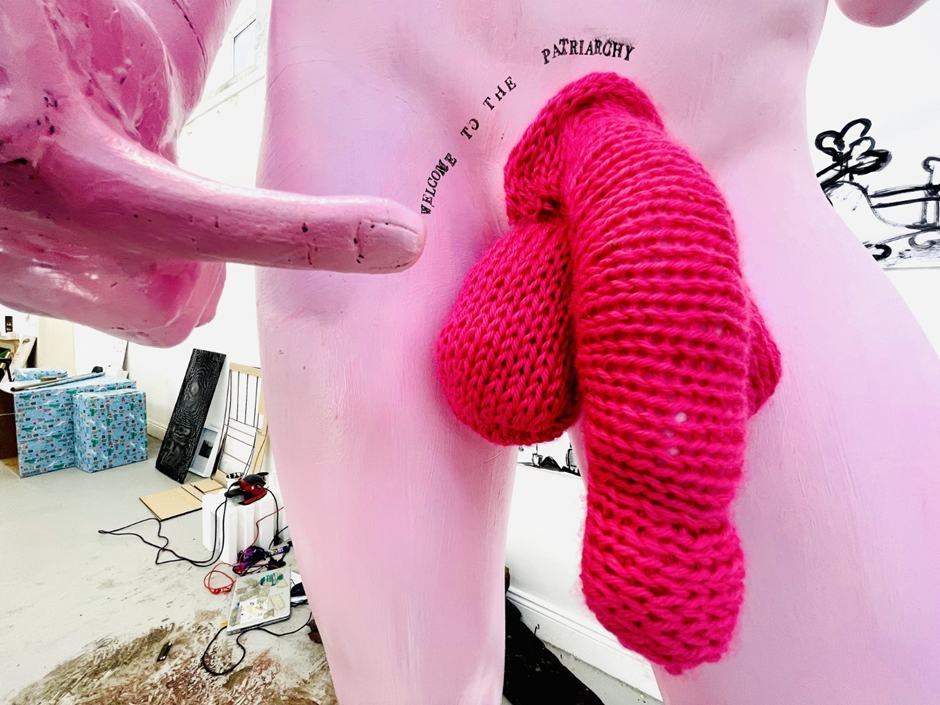
Censorship continues to manifest within educational institutions. In October 2023, an artwork exhibited in a certain art college was censored when its knitted phallus was ordered to be covered by faculty. The artist, acting under duress, complied to prevent damage to the piece. Entitled Giles, the sculpture references artists such as Ernst Ludwig Kirchner, Barkley L. Hendricks, Alice Maher, and Sally Hewett. A pink mannequin bearing a knitted penis stood upon a plinth, accompanied by an embroidered hassock reading “Kneel bitch” and the inscription “Welcome to the Patriarchy” on the figure’s groin.
Arthur Danto’s concept of “disturbation art” describes works that intentionally provoke critical discomfort to confront societal complacency. Epictetus’s observation that “Men are disturbed not by things, but by the view they take of them” underscores the subjective nature of offence. Works such as Doris Salcedo’s Shibboleth, Fernando Botero’s Abu Ghraib, and Robert Colescott’s Eat Dem Taters exemplify this principle, using shock to expose truths about race, violence, and power. As critic David Lefkowitz noted of Colescott, his art “contains something to offend nearly everyone,” thereby ensuring that all are implicated in its critique.
Freedberg (2016) reminds us that those who seek to suppress or destroy art “testify to its power.” Similarly, Anita Steckel’s declaration –
If the erect penis is not wholesome enough to go into museums, it should not be considered wholesome enough to go into women.
—captures the hypocrisy inherent in moral censorship. To restrict art is to deny its essential role as a mirror to society, a catalyst for discourse, and a force for transformation. Art’s capacity to disturb is not its failure but its triumph.
Lucy Lambe
Lucy is a sculpture and combined media artist who’s practice encompasses live art performance, painting, illustration, social practice and installation. From stabling horses in her studio, performing communion in a nightclub to orchestrating public engagement projects from her Green Sheep Studios, her art imitates her rather full and chaotic life at times – flying off on tangents but invariably landing in a place of nurture and empathy.

Anecdotes Issue 01
Read this article and more in our seasonal anecdotes art magazine
 No products in the cart.