
James Wellwood reflects on small-scale oil painting, walking and memory, tracing the landscapes and everyday encounters behind As It Darkens.
By James Wellwood | Anecdotes Issue 03
My practice functions as a document of everyday experiences and my immediate surroundings. I’m drawn to quiet, intimate moments, fragments of daily life that might otherwise go unnoticed. Through predominantly oil painting, and more recently sculpture and installation, I attempt to preserve these fleeting encounters while exploring how memory and atmosphere become embedded within place.
Although much of my painted work depicts landscape, I frequently work in portrait format rather than traditional landscape orientation. This largely stems from my interest in the sky, particularly the evening and night sky, which has become a recurring motif throughout the paintings. Regardless of location, the sky remains the one constant element within a landscape, acting as both a unifying presence and a marker of time. The vertical format also directly references the source material itself, as most of my research photographs are taken on my phone while walking. The majority of my paintings are made on small-scale canvases, usually 25 x 30 cm, as I’m interested in the intimacy this scale creates. Large paintings can often feel loud or overwhelming, viewed collectively and from a distance, whereas for me, smaller works encourage slower and more personal engagement.
My process typically begins with walking and observation, informed by the concept of “soft fascination”, a state of attention that allows focus to drift gently through a space rather than fixating on a single point or becoming draining. Walking becomes both a method of gathering material and a way of slowing down, allowing personal narrative and emotional associations to emerge gradually through repeated engagement with a space. Through these ideas, I approach each body of work as a site-responsive visual diary.
Locations carrying emotional or formative significance typically become the basis for exploring themes of memory, isolation, spatial perception, and narrative, considering how place is experienced both physically and psychologically. More recently, this has started to expand into unfamiliar environments, reflecting a curiosity in how perspective alters our relationship to place and how landscapes can feel both familiar and uncanny.
I’m drawn to quiet, intimate moments, fragments of daily life that might otherwise go unnoticed.
I do also have a particular interest in the subtle traces of human presence within rural environments, impressions that remain even when people themselves are absent. Fences, pathways, abandoned objects, and weather conditions become discreet indicators of activity, routine, and the history of a space. These details often form the starting point for works that exist somewhere between documentation and recollection.
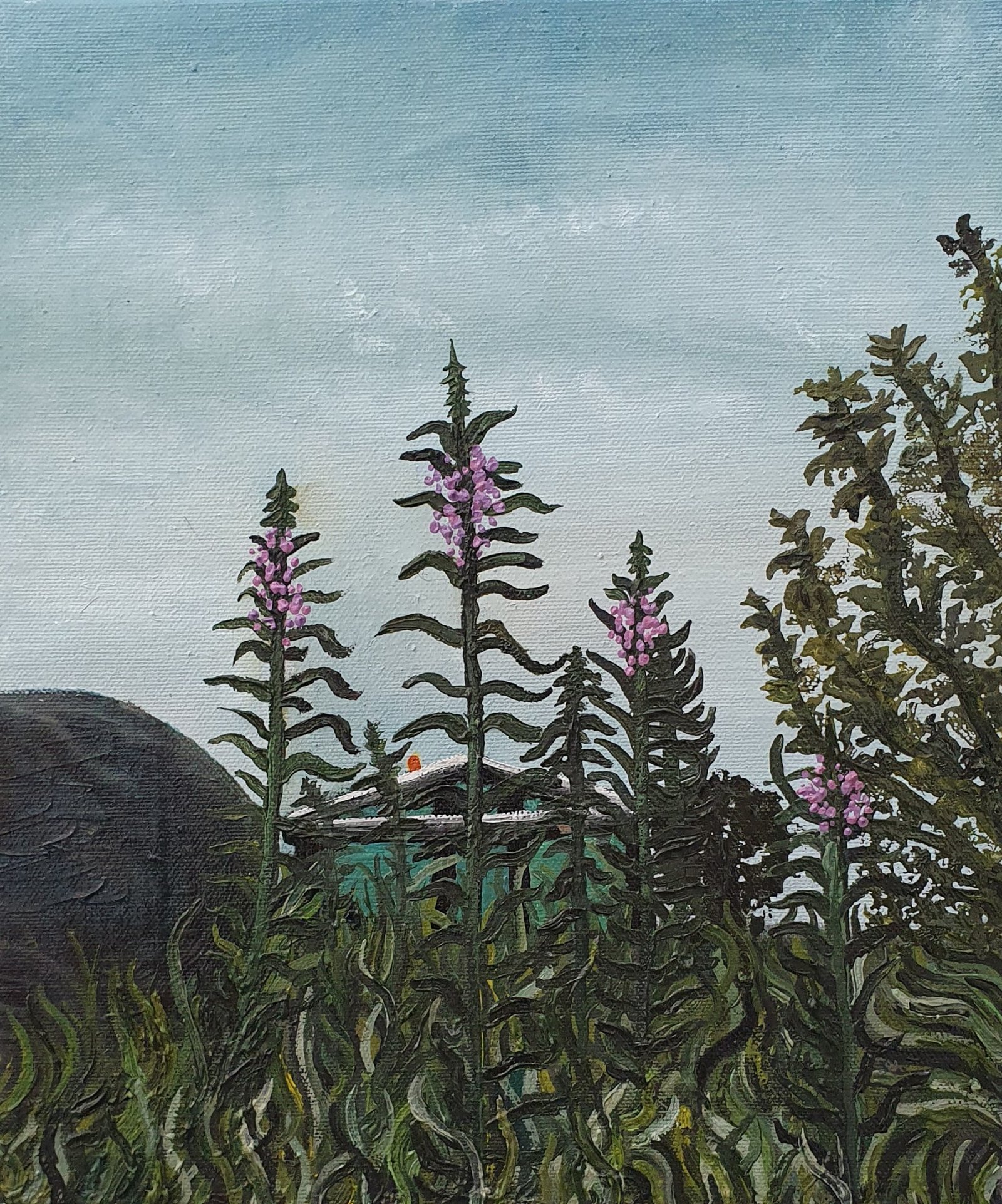
My most recent project developed over four years through image and object collecting on the dairy farm where I grew up. The work became an attempt to reconstruct and reconsider a familiar environment through the shifting perspectives of childhood, adolescence, and adulthood, with the landscape functioning simultaneously as subject and stage. What initially began as my degree show project at Limerick School of Art and Design gradually expanded into a larger body of work consisting of over sixty oil paintings, cyanotype prints, handmade publications, drawings, sketchbooks, and sculptural objects. The project was later revisited during the Artist Connect mentoring programme with Kilkenny Arts Office in Spring 2025. The work has been exhibited widely across Ireland in both group and two-person exhibitions and will culminate in a solo exhibition, As It Darkens, with Engage Art Studios as part of the 2026 Galway International Arts Festival.An earlier painting from the series, Fireweed, which will be included in the exhibition, encapsulates many of the ideas central to the project. The work reflects both my own awareness of the landscape and my relationship with it. Many of the paintings in this project are rooted in specific memories and seasonal experiences; in the case of Fireweed, summer walks and evening hikes across the farm.
Fireweed flowers from June through to September, carrying a strong seasonal presence much like daffodils in spring. Once a native plant with a more limited range, it has since spread widely across Ireland due to its ability to thrive on disturbed ground, often appearing along roadsides, in wasteland, open woodland, and, in this particular case, agricultural spaces or understand.
Anecdotes – 4 Issue Bundle
Own the complete Anecdotes collection. This bundle includes Issues 01–04, featuring 246 pages of contemporary art, artist essays and studio reflections in a premium A5 magazine format.


 No products in the cart.